
Breeder life & families · the individual dog comes first
Help a retired breeding dog settle into a new routine
Help a retired breeding dog settle into the next stage.
A new routine. The same dog.
Begin with what this dog knows, enjoys and needs. Keep useful familiarity, make room for choice and plan the practical care—whether retirement happens at home or with a new family.
Make a routine bridge sheet ↓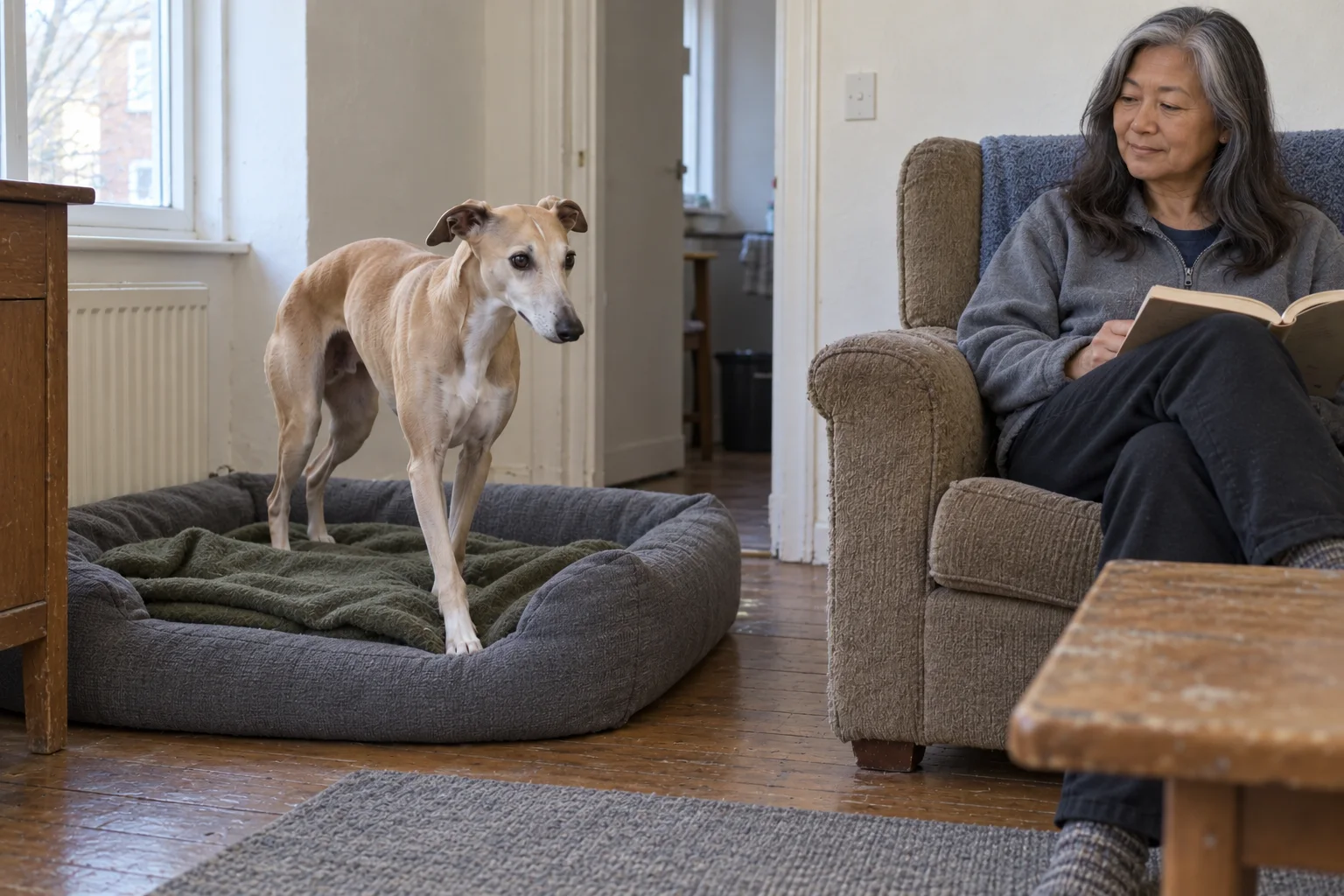
Retirement describes a change in role. Ask what else is changing.
Some dogs remain in the home they already know. Others move to a different household. Some are older; others are well within adult life. Start with that actual situation, rather than a single story about what a retired breeding dog must be like.
Write down what the dog already knows: familiar people, daily care, preferred resting places, trips outside and experiences away from home. Include the things you have not had a chance to observe. “Unknown” is more useful than turning an assumption into a confident handover.
Speak with the dog’s veterinarian about current health and any care changes. Reproductive retirement does not automatically make a dog senior. When a dog is actually in the senior life stage, the relevant senior-care guidance can inform an individual plan. Life-stage guidance ↗ Senior-care guidance ↗
Reference sheet 01 · connect the familiar and the new
Keep what helps.
Plan what changes.
Use these prompts with the next caregiver—or with your own household if the dog is staying.
| What to record | Keep this distinction |
|---|---|
| Rest and familiar space | Carry forward what already helps. Record where the dog chooses to rest, familiar bedding and what makes that spot comfortable. Plan a quiet place with room to step away. |
| Food and everyday care | Give the next caregiver the actual routine. Share current instructions and relevant records. Discuss health, nutrition or activity changes with the dog’s veterinarian. |
| People and handling | Describe what this dog knows. Note familiar cues, comfortable interactions and handling that needs care. Allow the dog to approach without being crowded. |
| Doors, surfaces and trips outside | Walk the real route. Check how the dog will reach the toileting area and navigate the home. Identify unfamiliar stairs, slippery surfaces and access arrangements to discuss. |
| Company and time apart | Do not assume a new routine will feel familiar. Describe the dog’s previous experience and arrange care for the new household’s actual day. Seek qualified help for distress or concerning changes. |
| Changes you notice | Keep a dated observation, not a settling deadline. Record what changed, when and in which context. Contact the veterinary team about concerns rather than explaining everything as adjustment. |
Original Good Harbor transition reference. Observe the individual dog; these prompts do not set a universal care schedule.
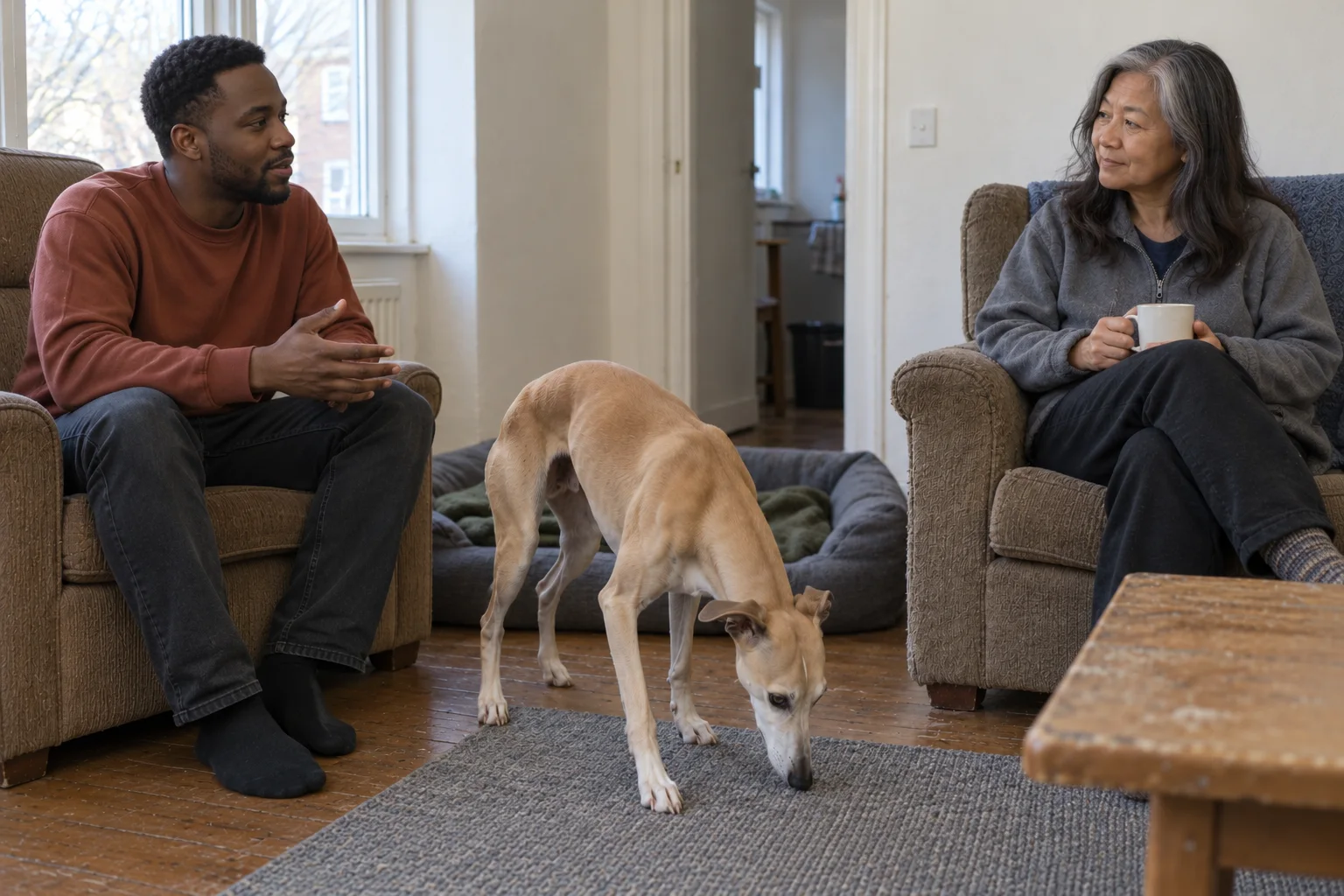
Let the welcome be quiet enough to understand.
A new household can be keen to meet the dog all at once. Plan a calmer start, with a comfortable place to rest and the option to move away from interaction. People can be friendly without gathering around or reaching in.
NAWT’s rehoming guidance emphasizes calm space, routine and gradual introductions. Those are useful general principles for planning an adult transition; they do not tell you exactly how a particular retired breeding dog will respond. Rehoming guidance ↗
Talk through the unglamorous details. Which door leads outside? Who will handle care during work? Where can the dog rest undisturbed? Does the next caregiver know the familiar cues and have the current instructions? A warm welcome still needs someone who can find the lead.
The research gives us questions, not a countdown.
A 2023 study assessed 590 adult dogs in 30 US commercial breeding kennels. A much smaller group—32 dogs—had owner-reported follow-up one month after rehoming. That is relevant retirement-specific evidence, but the voluntary, short follow-up cannot represent every retired breeding dog or every kind of breeding home. Read the original study ↗
No dogs in that follow-up sample were returned during the study window. That is encouraging within its limits. It is not a guarantee, a universal success rate or evidence that every dog will be settled by a month.
Keep expectations individual. You don’t need to attach a fixed three-day, three-week or three-month deadline to this dog. Watch what is happening and arrange appropriate help when needed. A timeline can become unhelpful if it persuades someone to wait through a concern or judge a dog for not meeting it.
Pass on observations without turning them into promises.
Describe what you have seen and the circumstances in which you saw it. A dog who rested comfortably with familiar people may find a new household different. A dog with little experience of a particular task may need appropriate support; that does not give you a reason to assume every other part of life will be difficult.
Agree how the people involved will stay in touch and what information would help. Invite both the ordinary good moments and the awkward ones. If concerns arise, use the veterinary team and qualified behavior support rather than asking a new caregiver to improvise treatment from a checklist.
Reference sheet 02 · make it useful
From the familiar day to the next one
Complete this for the individual dog, with the people who will provide care. Describe what you know, what will change and the questions still needing a professional answer.
From the familiar day to the next one
Date / version: ____________________
Retirement does not automatically mean senior age or a new home. This sheet records a transition; it does not prescribe treatment or a settling timetable.
Notes stay on this page until you leave or reload. Download a copy to keep them. This page does not save notes to an account.
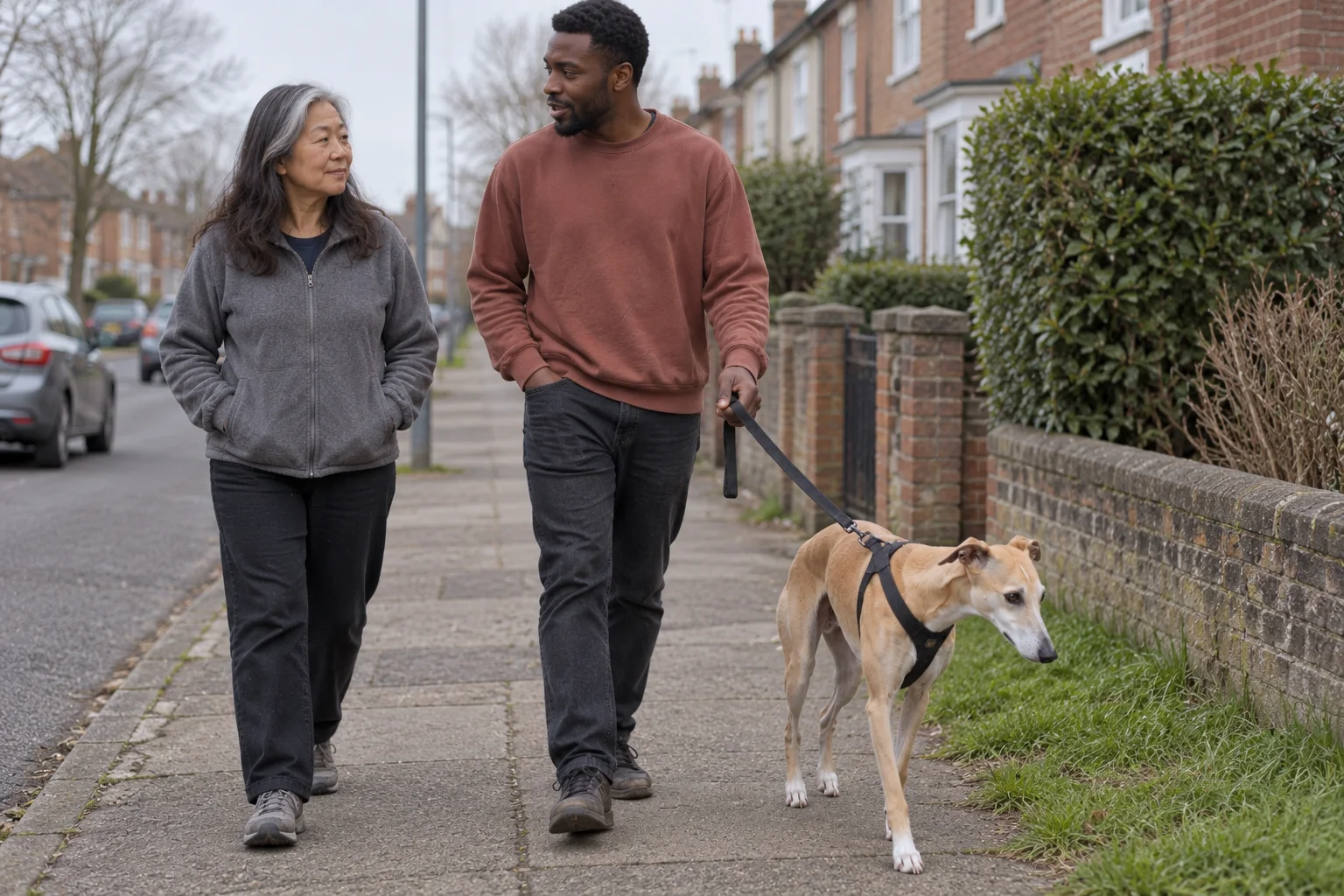
Make the next day workable.
Carry forward a useful routine, a familiar cue or a comfortable resting place. Confirm who provides the care and how they will get help. Leave a dated record of the things still unknown.
Retirement does not require a dog to become somebody else. Your job is to understand the individual in front of you and make the next stage of daily life work for them.
Read further
What we know—and what we can’t promise.
Retirement-specific research is limited. General rehoming and veterinary guidance can help with practical planning when its scope stays clear.
- National Animal Welfare Trust
Settling in Your New Rescue Dog ↗
General rehoming guidance on calm space, routine and gradual introductions. Applied cautiously to an adult transition; rescue guidance is not retirement-specific experimental evidence. No fixed settling deadline is adopted here.
- Barnard and colleagues · PLOS ONE
Management and behavioral factors associated with rehoming outcomes ↗
2023; 18(3):e0282459. Assessments of 590 adult dogs in 30 US commercial breeding kennels; a convenience follow-up of 32 owners one month after rehoming. The short, voluntary follow-up cannot establish a universal outcome or adjustment timeline.
- American Animal Hospital Association
2019 Canine Life Stage Guidelines · checklists ↗
Published October 8, 2019. Professional guidance recommends behavior history and open-ended questions across life stages; care should reflect the individual dog.
- Katherine Pankratz · Merck Veterinary Manual
Diagnosis of Behavior Problems in Animals ↗
Reviewed September 2024; updated June 2025. Clinical assessment considers history, context and possible medical causes. A breeder record or conversation does not replace that assessment.
- American Animal Hospital Association
2023 Senior Care Guidelines for Dogs and Cats ↗
Professional guidance for pets who are actually senior. Reproductive retirement alone does not put a dog in that life stage.
How the evidence is used
Barnard et al. (2023), Methods and post-adoption results: 590 adult dogs assessed in 30 US commercial breeding kennels; 32 owners provided one-month follow-up, a convenience sample, predominantly female dogs, ages 2–8. The initial assessment sample and follow-up sample answer different questions; 32/590 is not reported here as a rehoming-success or response rate.
The study’s no-return observation applies only to its short follow-up sample and does not establish universal success. It cannot provide a fixed settling timeline or the ideal home for every retired dog. No research figure is copied and no numerical chart is produced.
NAWT rescue guidance supports calm space, routine and unforced introductions as general principles, not retirement-specific experimental findings. AAHA life-stage history applies across ages; 2023 senior guidance applies only to dogs who are actually senior. Merck supports assessment of medical causes rather than dismissing change as adjustment.
Finished reading?
Keep track of the guides you’ve explored.
Sources checked October 10, 2026.