
Everyday litter care / Cleaning & care
Cleaning and disinfecting the puppy room are different jobs
The bowl can look clean before the job is finished. Start by knowing which job you’re doing.
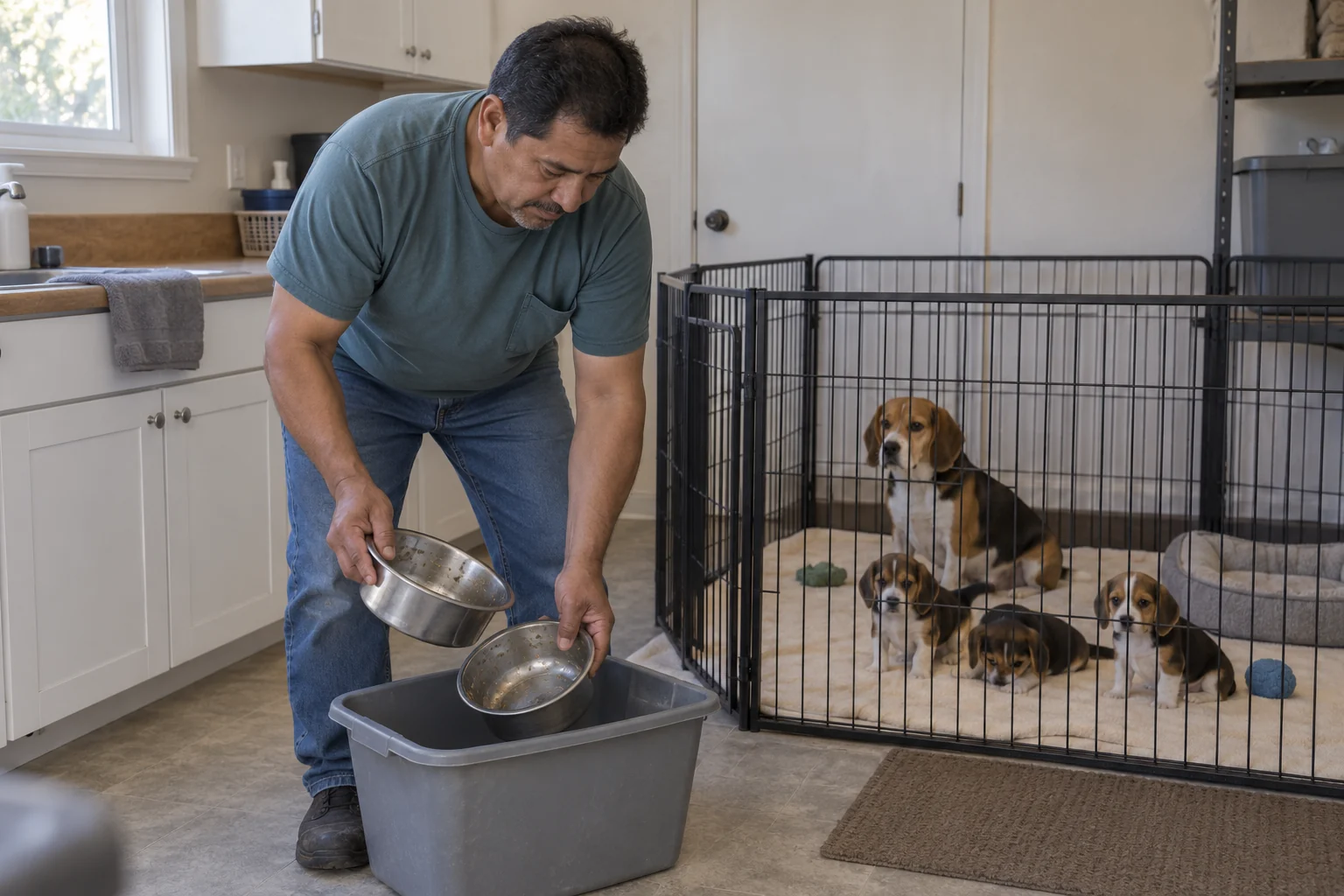
Cleaning removes material from a surface. Disinfecting uses a suitable process to act on germs. A quick spray doesn’t make those jobs interchangeable.
For everyday litter care, the useful question is what this particular item needs before it goes back into use. A feeding bowl, a washable blanket and a cracked plastic toy are different objects. Treating them all to the same hurried wipe is convenient mainly for the person holding the wipe.
This article helps you separate the tasks and read the relevant directions. It doesn’t choose a disinfectant or set a cleaning schedule for your litter. Age, illness and the actual setting belong in that decision with your veterinarian.
Remove the material first.
Start with the item, not the bottle. What is on it? What is it made of? Can you reach the underside, seam or rim? A steel bowl can collect a ring of dried food under an edge that looks perfectly respectable from above.
CDC distinguishes physical cleaning with soap or detergent from chemical disinfection. It also notes that young animals and illness can call for extra care. Its general household examples should not become a calendar for every breeding home. CDC
APHIS explains why removal matters: organic material can interfere with disinfectants. Its veterinary reference describes a much broader process than washing a puppy bowl, but the practical point travels well—leaving material behind can undermine what follows. APHIS
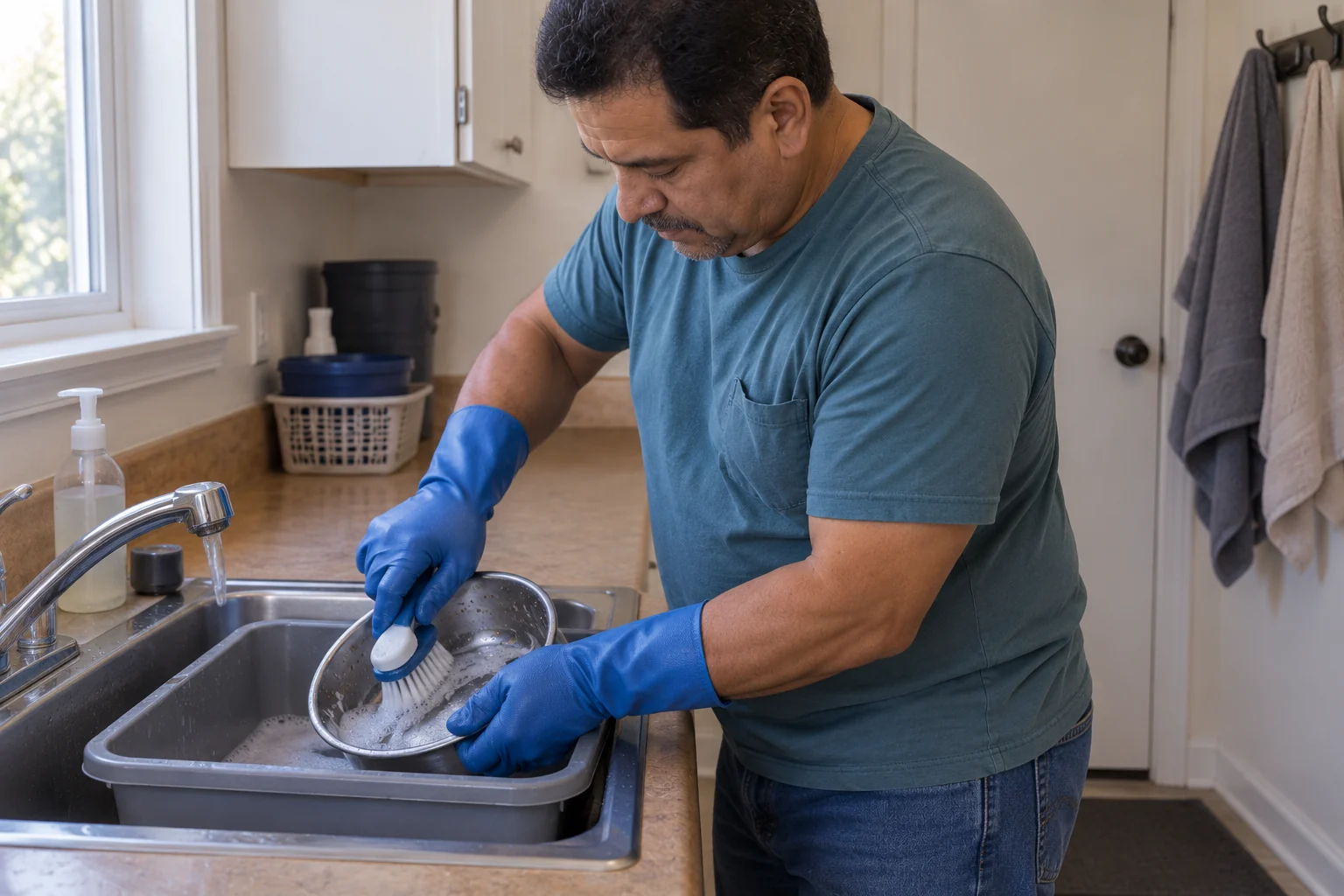
Read the directions for this use.
A front label may promise a great deal in very large letters. Turn the container around. EPA explains that directions specify where a disinfectant can be used, how to apply it and the time needed for a particular use. The surface must remain visibly wet for the required contact time. EPA
That means “I sprayed it” is an incomplete description. So is “I left it a while.” Find the relevant directions before beginning, including any preparation, protective equipment, ventilation, rinsing, drying and animal re-entry instructions. A product can have more than one set of directions. Reading the first number you find is an efficient way to answer the wrong question.
If a label is damaged or you cannot tell whether a use is covered, stop and resolve that uncertainty. Keep the original directions available to everyone doing the work. A handwritten bottle name is not enough to reconstruct what belongs in it or how it should be used.
Ask your veterinarian about an appropriate plan when illness or a particular disease threat changes the situation. APHIS emphasizes that methods depend on the organism, product and conditions; its protocols do not override the actual label. APHIS
Give the washing work its own space.
Have somewhere to collect used items, somewhere to work on them and somewhere protected for items ready to return. These can be ordinary practical places. The important distinction is their job, not whether the containers match.
Keep animals away from cleaning and disinfection, follow safe handling directions and do not mix cleaners. CDC recommends pet-only washing tools for relevant items and explains how to clean the sink or tub afterward. CDC
Before starting, look at the route back to the litter. Will the bowl have to sit beside the used stack while you open a door? Will the towel you use to dry it then join the ready pile? Those are ordinary workflow problems you can solve before the work is underway.
Hands are part of that route too. Wash them with soap and water after handling animal equipment and waste, as CDC advises. A pair of gloves or a tidy bench doesn’t turn everything touched afterward into a clean item. CDC hygiene

Check what is ready to return.
The last part of the job is deciding where the item belongs next. Has it completed the relevant process? Have any required rinsing, drying or other return-to-use conditions been met? Is its storage place still ready for it?
Also look at the object itself. A split edge, damaged seam or hard-to-reach residue is worth noticing before it disappears into the cupboard. Ask whether the item can still be maintained appropriately; a new storage tub cannot repair a damaged bowl.
If more than one person cares for the litter, agree what “ready” means and how unfinished work is kept separate. “I thought you’d done that” is an avoidable stage of the process. Use the blank sheet below to find the relevant directions together, then keep the actual label as your authority.
Keep a useful copy
Read the label before the job.
Use this blank sheet to locate the directions for a specific item and intended use. Copy only from the actual label; leave an unresolved field blank and ask for help.
Optional notes stay in this page until you reset or reload it. Download a text copy to keep them. Nothing is sent or saved to an account.
Finish the task, then put it away.
A useful cleaning setup makes it clear what is used, what is being worked on and what can go back. Knowing the difference between cleaning and disinfection gives each part of that setup a purpose.
Finished reading?
Keep track of the guides you’ve explored.
Read further
Sources & scope
- CDC · Cleaning and disinfecting pet supplies
February 18, 2026. Household guidance: cleaning, higher-risk circumstances and safe handling. Its example household schedule is not a litter-care protocol.
- EPA · Selected EPA-registered disinfectants
Updated August 24, 2026. See Directions for Use: intended sites, application and wet contact time. The actual product label controls.
- APHIS · Cleaning and disinfection
Modified January 13, 2026. NVAP veterinary reference; Cleaning, Disinfection and Safety sections. Program-level guidance is not a universal household recipe.
- CDC · Hygiene practices around animals
January 31, 2025. Best practices for human handwashing after animal and equipment contact; household risk discussion.