
Everyday litter care / Room & routine
Make the puppy room easier to work in
Give the everyday work a place to happen.
Then see where your feet—and your hands—actually go.
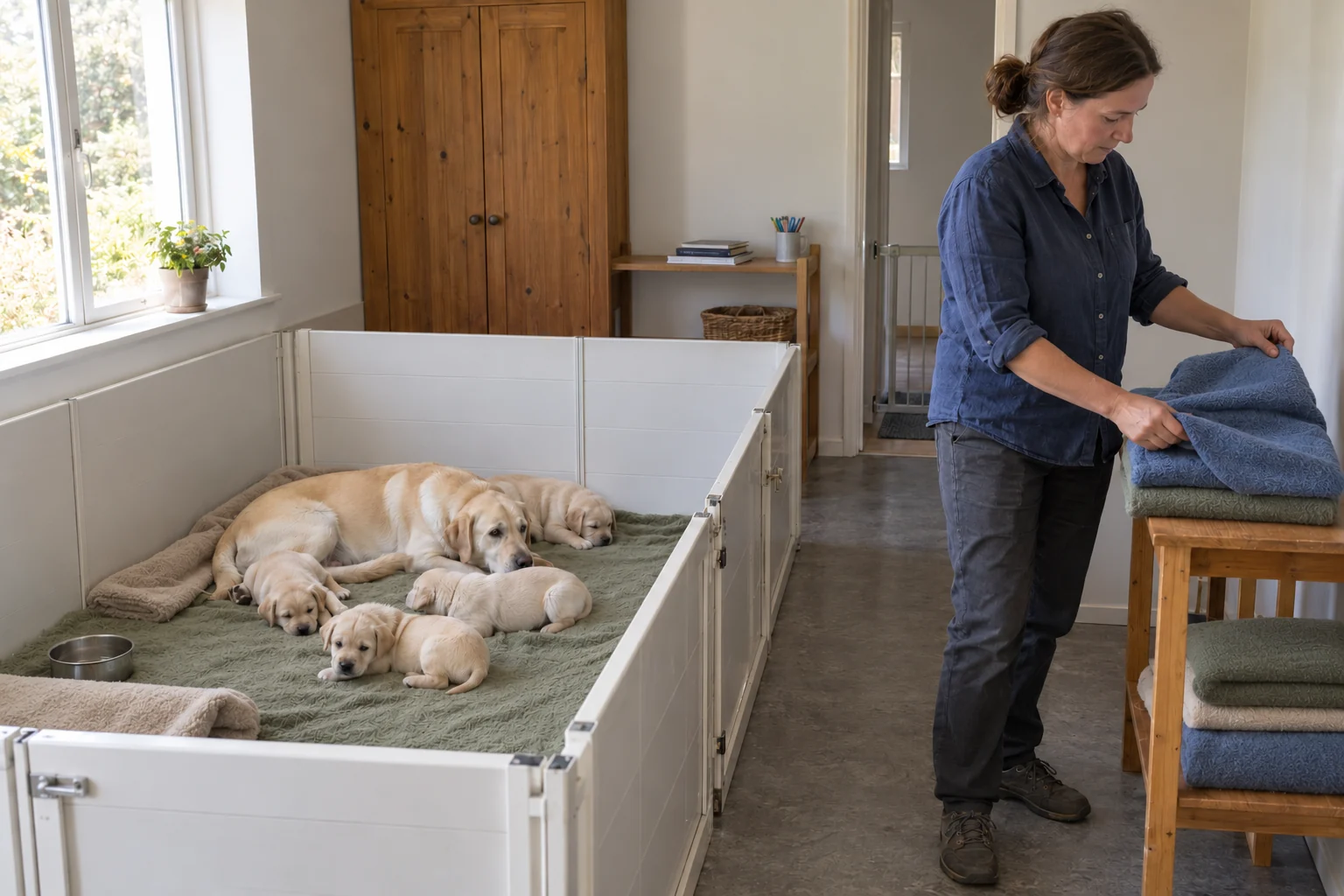
A useful puppy room gives you somewhere to put the fresh towel, somewhere different to put the used one, and enough space to do the job without a small expedition.
You don’t need matching baskets. Start with the enclosure and the litter’s needs, then give supplies, used items and notes distinct homes. Walk one ordinary task through the room before you buy anything. That’s where the awkward corner usually introduces itself.
This is about arranging everyday work around an existing, appropriate puppy setup. A whelping space, a sick puppy’s care area and an active older litter have different needs. Keep age-specific housing, warmth, ventilation and illness arrangements with your veterinarian; a tidy floor plan can’t settle them. [1]
Walk the job before you move the furniture.
Choose something you already do: replacing a piece of bedding, collecting used bowls, or sitting down to observe the litter. Start where you normally start. Open the cupboard. Open the pen gate. Find the item. Decide where it goes afterward.
Notice each place you stop because your hands are full. If the only free surface is holding tomorrow’s clean cloths, the room is asking you to mix two jobs. If you have to step over a bin to reach the gate, the bin has nominated itself for a new home.
Try this first without carrying a puppy. Then check that the arrangement still makes sense when another caregiver is there, a door is open, and you need to reach the whole enclosure. Leave access to exits clear.
Give four kinds of work their own homes.
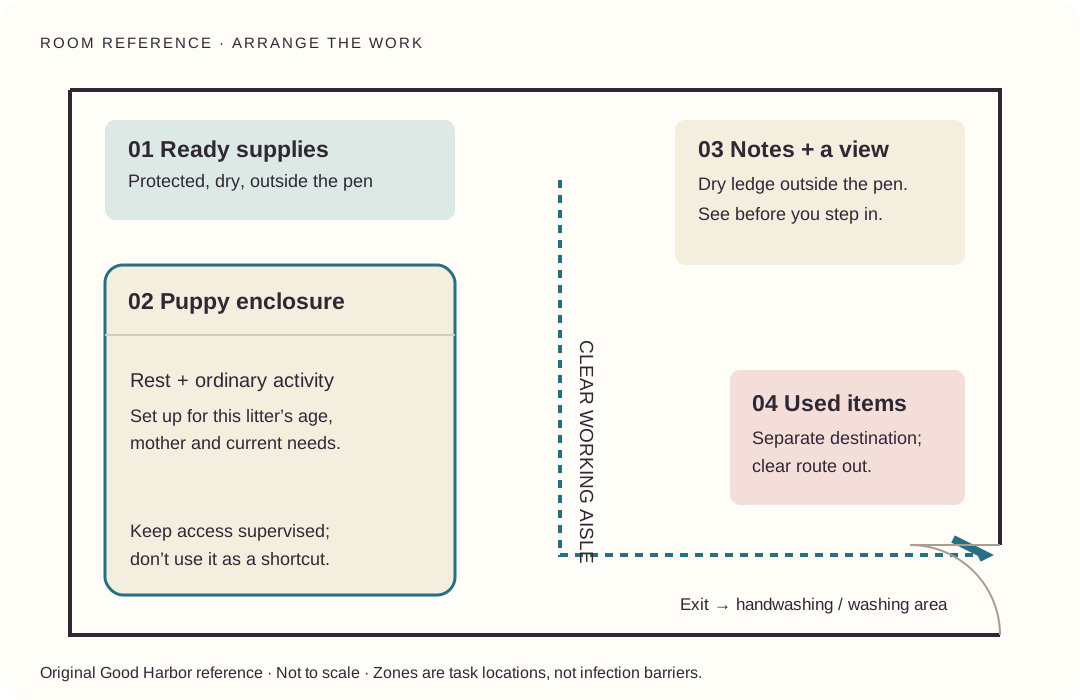
Room reference · arrange the work
↓ Clear working aisle to exit
→ Handwashing / washing area
Not to scale. Adapt positions to your room.
Read the room reference as a table
| Location | Purpose | Ask yourself |
|---|---|---|
| Ready supplies | Protected, dry items outside puppy reach | Can I take one without touching the rest? |
| Puppy enclosure | Resting and ordinary activity | Can I observe and work without using it as a walkway? |
| Notes and a view | A dry ledge outside the pen | Can I see the whole litter? |
| Used items | A separate destination and route out | Where does bedding go before laundry? |
| Working aisle | Clear movement and access | Can doors and lids open? |
| Handwashing / washing | Facilities suited to the task | Where do I go after contact with animals, equipment or waste? |
Let the puppy space remain puppy space.
The enclosure shouldn’t become your shortcut, drying rack or spare cupboard. Keep working supplies outside it. When you review the arrangement, include the mother’s needs and the puppies’ changing activity, not just whether everything fits.
The Association of Shelter Veterinarians describes rest, retreat and choice as parts of dogs’ welfare. Its population-care guidance includes breeding operations in its audience, but it isn’t a design specification for this litter. Use those needs as questions to ask about your setup. [2]
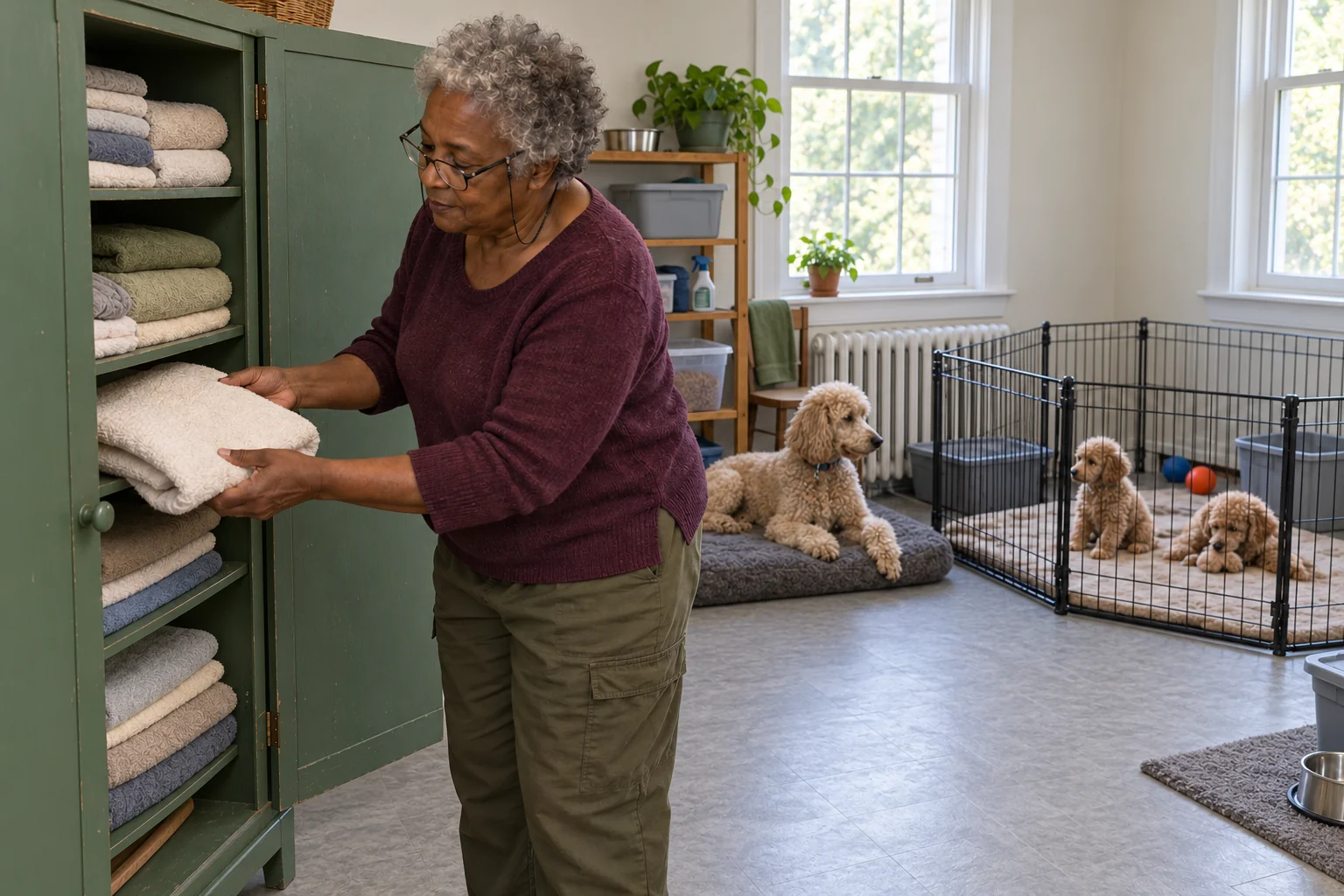
Make “ready to use” easy to recognize.
A closed cupboard or suitable covered container can give dry, ready supplies a clear home. Keep only the amount you need at the working spot; protect the rest from splashes and used items. A clean-looking pile doesn’t tell the next person whether it’s been used.
Give notes a dry place outside the pen too. A notebook perched on a linen stack tends to move just when you need it. You should be able to look at the litter before reaching for a pen, and put the notebook away without balancing it on a puppy barrier.
Check what the storage itself is made of. Can you reach behind it? Can its surfaces tolerate the cleaning they need? ASV’s facilities guidance makes cleanability a design consideration; the pretty basket still has to earn its shelf space. [2]

Give used items a route out.
Used bedding needs a destination before you lift it. Choose a suitable container and a route to the laundry or washing area that keeps it away from ready supplies. Used bowls need their own destination too; “on the bench for a moment” is how a bench acquires a second career.
A lid can help contain a load during transport. It doesn’t make the outside of the container clean, and it doesn’t turn that container into a place for fresh stock. Plan how the container itself gets cleaned, dried and returned.
Put handwashing into the route you actually take. CDC recommends washing with soap and water after handling animals, their equipment and waste. A conveniently placed bin doesn’t replace that step. [3]
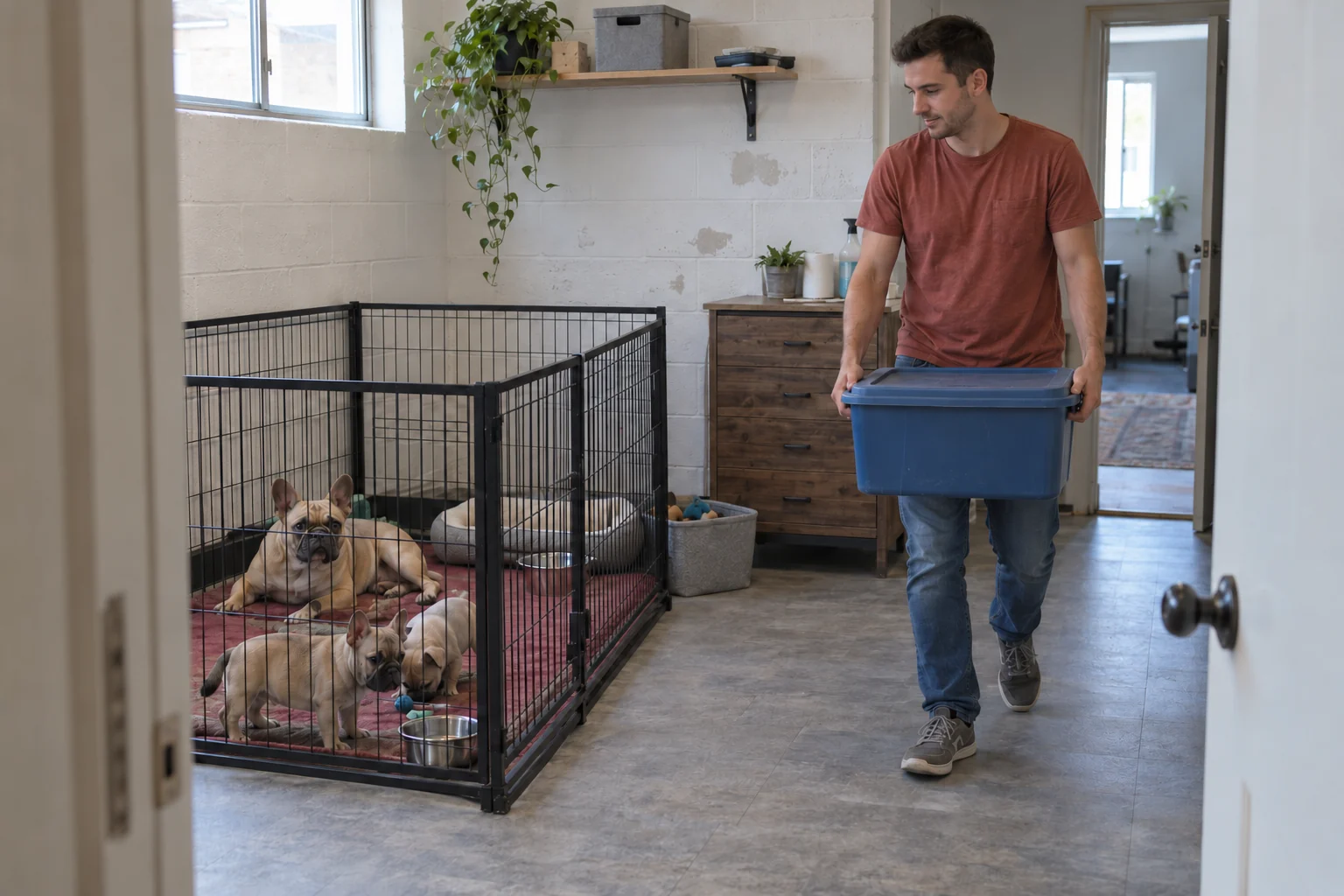
Reference 02 · Follow the object
Two journeys, one working space.
- Protected, dry stock
- Take only what you need
- Use with the litter
- Separate collection point
- Appropriate cleaning / laundry
- Dry, then return to ready stock
Keep a handwashing point in your route. This drawing describes item handling; the cleaning method depends on the item, its instructions and the situation. Food, chemicals and medicines need their own appropriate storage.
Leave space—and time—for the room to reset.
Easy to reach is only half the job. Ask where an item can dry, where animals will be while an area is cleaned, and how you’ll stop someone putting a wet item straight back into use.
Cleaning removes dirt; disinfecting is a different job. When disinfection is needed, use a product suitable for the intended surface and organism, and follow its label for preparation, application, wet contact time, any rinsing and safe return. EPA explains that the surface must remain visibly wet for the labeled contact time. Don’t invent a dilution or shorten the wait to fit your room routine. [4]
CDC advises keeping pets away during cleaning and disinfection and storing disinfectants out of reach. Give that separation a practical place in your arrangements. Don’t spray around the litter because the supply cupboard happens to be nearby. [5]
A useful source distinction
There isn’t one cleaning method for every situation.
“No single method is adequate for all situations.”USDA APHIS · NVAP Reference Guide
USDA APHIS’s cleaning and disinfection reference is written for accredited veterinarians and animal-health programs. It explains why the organism, material and environment matter. Its program procedures aren’t a ready-made home-litter protocol. Ask your veterinarian about illness or a suspected outbreak; moving the laundry bin isn’t isolation. [6]
Read the APHIS reference ↗What can research tell us about a clean-looking room?
A Brisbane shelter study sampled surfaces before and after routine cleaning and disinfection. It investigated bacterial contamination, not the appearance of the room or the success of a particular floor plan. Its setting included a veterinary clinic and shelter housing, with seven target locations sampled over three weeks. That’s useful context for taking hygiene seriously; it doesn’t supply a disease-reduction percentage for your home puppy room. [7]
The room map here is an original practical reference. No study inspected establishes its dimensions, zone spacing or effect on health.
Reference 03 · A blank practical aid
Let one real job test the room.
Before reorganizing everything, write down one task and the place it catches. Make one change, then walk it again. A different shelf position may do more for you than another storage order.
These notes stay in this page until you reload or leave. Download a text copy to keep them. Nothing is sent to pupID or saved to an account.
A room that works is a room you can explain.
Show the next caregiver where a fresh item starts, where a used one goes, and where to look at the litter without getting in the way. If that explanation takes a tour of three cupboards, you’ve found your next small improvement.
Finished reading?
Keep track of the guides you’ve explored.
Sources & editorial notes
What supports the advice.
Sources checked October 10, 2026.
- Merck Veterinary Manual · Management of the Neonate in Dogs and Cats
Autumn P. Davidson. Reviewed December 2022; updated August 2025. Husbandry and Warmth sections support keeping neonatal needs separate from a general room arrangement.
- Association of Shelter Veterinarians · Guidelines for Standards of Care, second edition
2022. Facilities (§4), Sanitation (§5), Enrichment (§9.3). Expert consensus for population care; includes breeding operations. No source floor plan is reproduced.
- CDC · Hygiene Practices Around Animals
January 31, 2025. Public handwashing guidance after animal, equipment and waste contact.
- EPA · Selected EPA-Registered Disinfectants
Updated August 24, 2026. Directions for Use and labeled wet contact time; not an endorsement of a product.
- CDC · Cleaning and Disinfecting Pet Supplies
February 18, 2026. Household pet-supply guidance and safe chemical handling. No universal cleaning schedule or dilution is adopted here.
- USDA APHIS · Cleaning and Disinfection
NVAP Reference Guide; accessed October 10, 2026. Veterinary/program context, efficacy factors and safety.
- Environmental Recovery of Nosocomial Bacteria in a Companion Animal Shelter Before and After Infection Control Procedures
Frontiers in Veterinary Science, January 20, 2021. Methods and Discussion; environmental sampling at one Brisbane shelter, not a puppy-room layout trial.
- Jill Cline · Kennel Management and Nutrition of the Bitch and Her Offspring
Chapter 1, pp. 1–4, in Lopate (ed.), Management of Pregnant and Neonatal Dogs, Cats, and Exotic Pets, first edition, Wiley, 2012. Lawful publisher excerpt. Background on facilities/materials; its historical numerical claims and recipes are not adopted.