
Breeding & research / DNA testing / Interpretation
What a carrier result means for a breeding dog
Read the exact condition and inheritance pattern first. A carrier result is information to interpret, not a complete breeding decision.
Keep a question sheet ↓
The word “carrier” can make a report sound like a verdict. For a specified autosomal recessive variant, it generally describes a dog with one copy of that variant. What it means for health and offspring depends on that particular variant, its inheritance and the other parent’s result.
Keep those details attached. “Carrier” does not automatically mean clinically affected, and it does not automatically decide whether a dog should be bred.
Look closer
Name the condition before interpreting the label.
Read the gene or variant, the laboratory’s result key and the mode of inheritance. An autosomal recessive model is different from a dominant condition, an X-linked condition or a marker associated with increased risk. The same everyday word can conceal very different biology.
On the VGL PRA-prcd test, N/PRCD means one copy of the PRCD variant. The laboratory describes these dogs as carriers, not expected to develop this PRCD form of retinal degeneration. That interpretation is specific: other forms of progressive retinal atrophy are still possible. Read Explanation of Results and Additional Details.
For two copies, the laboratory expects this form of disease, while also noting exceptional clinically normal older dogs. That is one reason to distinguish a genotype from the timing and expression of clinical signs. Your veterinarian interprets the result with the dog’s history.
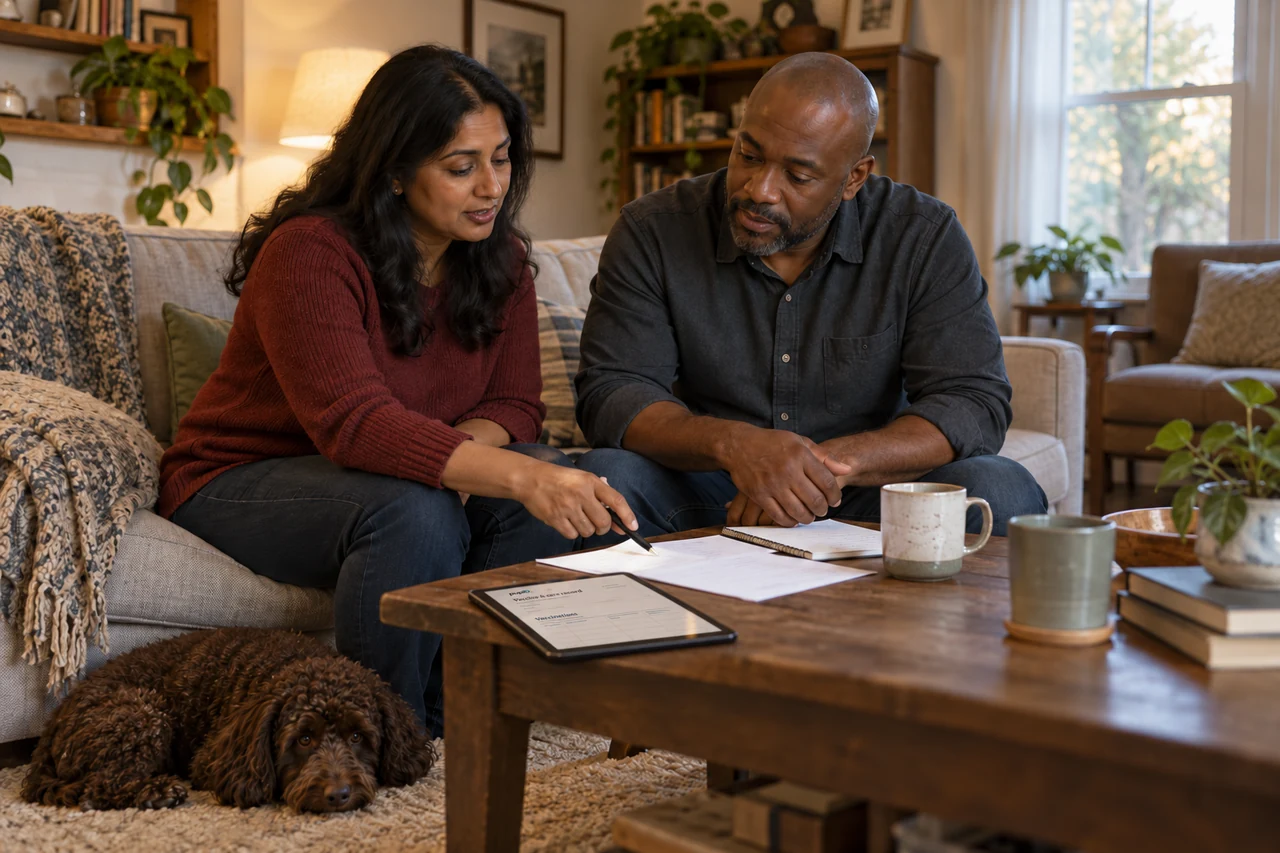
A useful first question
“Carrier of which variant, under which inheritance pattern?”
Look closer
Read probabilities one offspring at a time.
One specified autosomal recessive variant
Each parent contributes one copy.
N = tested variant absent · v = tested variant present
| Parent A ↓ / Parent B → | N | N |
|---|---|---|
| N | N/N | N/N |
| v | N/v | N/v |
Per offspring: 50% N/N, 50% N/v, 0% v/v.
Original Mendelian derivation informed by Abitbol, Chapter II, §I.3, PDF pp3–4. Compare the named-condition interpretation in VGL PRA-prcd. The model assumes a specified autosomal recessive variant and correctly established parental genotypes. It does not calculate breeding suitability or clinical penetrance.
Read every model without changing the control
N/v × N/N: 50% N/N, 50% N/v, 0% v/v.
N/v × N/v: 25% N/N, 50% N/v, 25% v/v.
N/N × N/N: 100% N/N, 0% N/v, 0% v/v.
Each parental copy has transmission probability 1/2; multiplying across parents gives 1/4 per cell. Identical cells are combined to obtain genotype probabilities. No observed litter data or confidence intervals are implied.
Download the derived combinations (CSV)A carrier can pass either copy at this locus. For two carriers, the model gives a one-in-four chance of two variant copies for each offspring. It does not promise that a four-puppy litter contains one of each outcome in the diagram.
Likewise, an N/v × N/N combination has no v/v outcome under this model, but some offspring can inherit the variant. “No two-copy outcome” and “no variant transmitted” are different statements. This is inheritance arithmetic for one target; it is not a complete assessment of a proposed mating.
Look closer
Keep DNA findings and disease records together.
A dog can look healthy while carrying a recessive variant. A young dog with a relevant genotype may also be too young for a late-onset condition to appear. Clinical history and follow-up therefore matter when researchers investigate what a result predicts.
Donner and colleagues’ 2023 study examined selected variants and clinical records in commercial samples. The clinical subset’s young age limited conclusions about late-onset disease. A large sample of DNA tests cannot, by itself, provide a complete lifetime health history. Read Clinical data evaluation and the Discussion limitations.
If a result is unexpected, clarify it with the laboratory and your veterinarian before acting on it. Confirm the dog’s identity, exact target and result wording; ask whether the finding needs further investigation. A remembered parental result or a broad “clear” label is not a substitute for checking the actual reports.
Look closer
Discuss the whole breeding question.
UC Davis geneticists explain that testing for recessive conditions can preserve useful breeding options while avoiding affected offspring from the specified condition. That does not amount to blanket approval for every carrier or every pairing. Read the faculty explanation.
Ask how the condition fits with the dog’s other health information, temperament, reproductive history and relationship to potential mates. The Merck Veterinary Manual’s breeding soundness chapter describes a broader assessment than DNA testing alone.
Population context belongs here as well. Automatically discarding every carrier can remove other useful variation from a breed. Ignoring a meaningful result creates a different problem. Take both parents’ original reports and specific questions to a veterinarian with relevant genetics expertise, so the discussion addresses the condition and the dogs together.
Keep the useful part
Prepare a carrier-result discussion.
Keep the exact result, the partner information and the wider breeding questions on the same page. Notes stay in this tab. Export them before closing to keep a copy.
Original blank reading aid. No information is sent to an account. This sheet records questions; it does not calculate breeding suitability.
Follow the evidence
Read the original sources.
- UC Davis VGL: PRA-prcd
- Marie Abitbol, Genetic testing in dogs, Chapter II
- Donner et al. (2023), clinical relevance
- Amy Young (2023), UC Davis: what testing can tell you
- Merck Veterinary Manual: breeding soundness examination
Finished reading?
Keep track of the guides you’ve explored.