
AAHA · Age and behavior
2015 Canine and Feline Behavior Management Guidelines; web publication May 10, 2019. Individual development, fear and avoiding forced exposure.
Observation before interpretation
Watch what changed, what the puppy did, and what happened next. You can stop an experience before you have a perfect explanation.
Start with what you can see
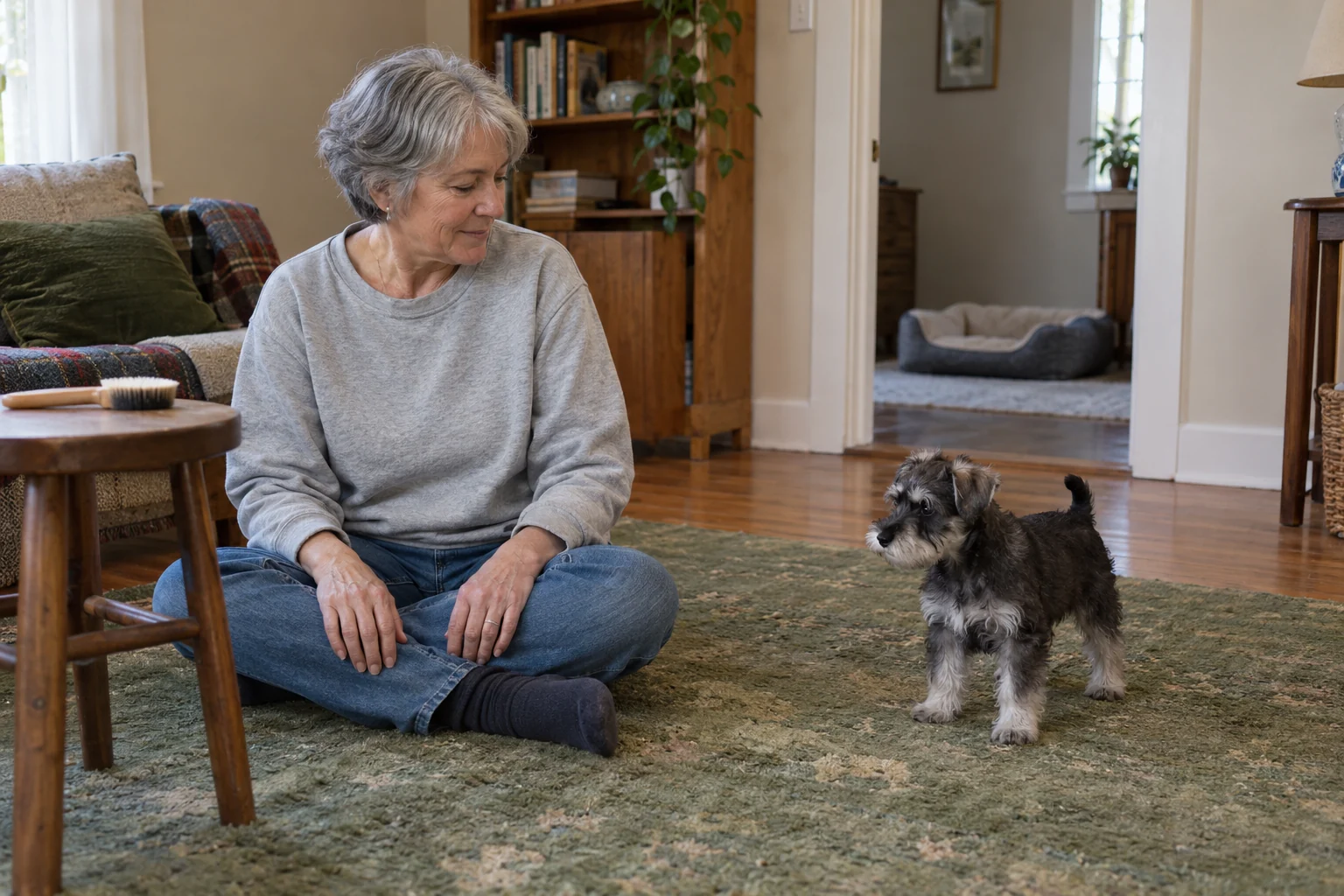
A puppy moves away as a hand reaches closer. Another stops exploring when an object begins to move. Your first job is to notice the change and stop adding pressure. You do not need to decide exactly what the puppy is feeling before setting a brush down or ending a greeting.
Withdrawal, freezing or attempts to escape warrant stopping the experience. AAHA recommends veterinary guidance for puppies showing withdrawal or fear and warns that forced exposure can worsen fear. AAHA ↗
A still photograph cannot show what came before or how the behavior changed afterward. A yawn, a turned head or declining food also leaves questions open. Record the context rather than treating one action as a diagnosis. This is careful observation, not a test you need the puppy to pass.
Useful restraint
Words such as “dramatic,” “dominant” or “difficult” can close the discussion before it starts. An action described in context gives a veterinarian or qualified behavior professional more to ask about. If you are unsure what happened, write that down.
You can take uncertainty seriously without increasing the challenge to find out. Repeating the same difficult experience simply to get a clearer reaction adds pressure the puppy did not need.

Change the situation
Put the tool aside. Ask the visitor to stop reaching. Stop the movement or sound you control. Leave a clear route to an appropriate familiar resting area, and supervise the space. The human action should make the experience easier to leave.
Cornell’s cooperative-care guidance emphasizes voluntary participation and stopping before grooming becomes a struggle. That is useful here: familiarity with a brush is a different task from finishing a whole grooming job. Cornell ↗
There is no universal countdown that tells you when a puppy is ready to try again. Look at the broader situation and what advice you have received for that puppy. A nap is not a failed training session; nor does a quiet moment prove that every concern has passed.

Bring useful information
Contact your veterinarian when fear keeps recurring, a change is marked, or behavior changes suddenly. Include the activity, what you observed and what you changed. Behavior and physical health belong in the same conversation; a written note cannot establish the cause.
If care is necessary and the puppy cannot comfortably participate, ask the veterinary team how to proceed. Necessary treatment and optional practice have different demands. Do not keep repeating a difficult task while waiting for the puppy to accept it.
UC Davis describes socialization as controlled, positive experience and advises watching for stress. That places the emphasis on the quality of an encounter, rather than completing a list at any cost. UC Davis ↗
Remember the useful details
Use the sheet for an event worth remembering, especially one you want to discuss with a professional. It separates what you noticed from what you think it might mean.
You do not need a running score for every puppy. A few clear notes can support a better conversation than a long list of unqualified labels.
Blank working sheet
A neutral observation aid. Recurring fear or a marked or sudden change needs veterinary advice.
Download an editable text copyFollow the evidence
2015 Canine and Feline Behavior Management Guidelines; web publication May 10, 2019. Individual development, fear and avoiding forced exposure.
Aly Cohen, extension veterinarian, February 2026. Gradual practice, voluntary participation and professional support.
Claire Youngerman, April 10, 2019. Positive, controlled experiences with people and everyday environments.
Sources checked October 10, 2026.
Finished reading?
Keep track of the guides you’ve explored.