
Fratkin et al. · Personality Consistency in Dogs
PLOS ONE 8:e54907 (2013). Methods and Overall Consistency results; 31 studies. Original figure uses the published random-effects estimate and confidence interval. CC BY.
Reading the research
A test can describe a puppy’s behavior in a particular situation. How much of the future does that description reveal?
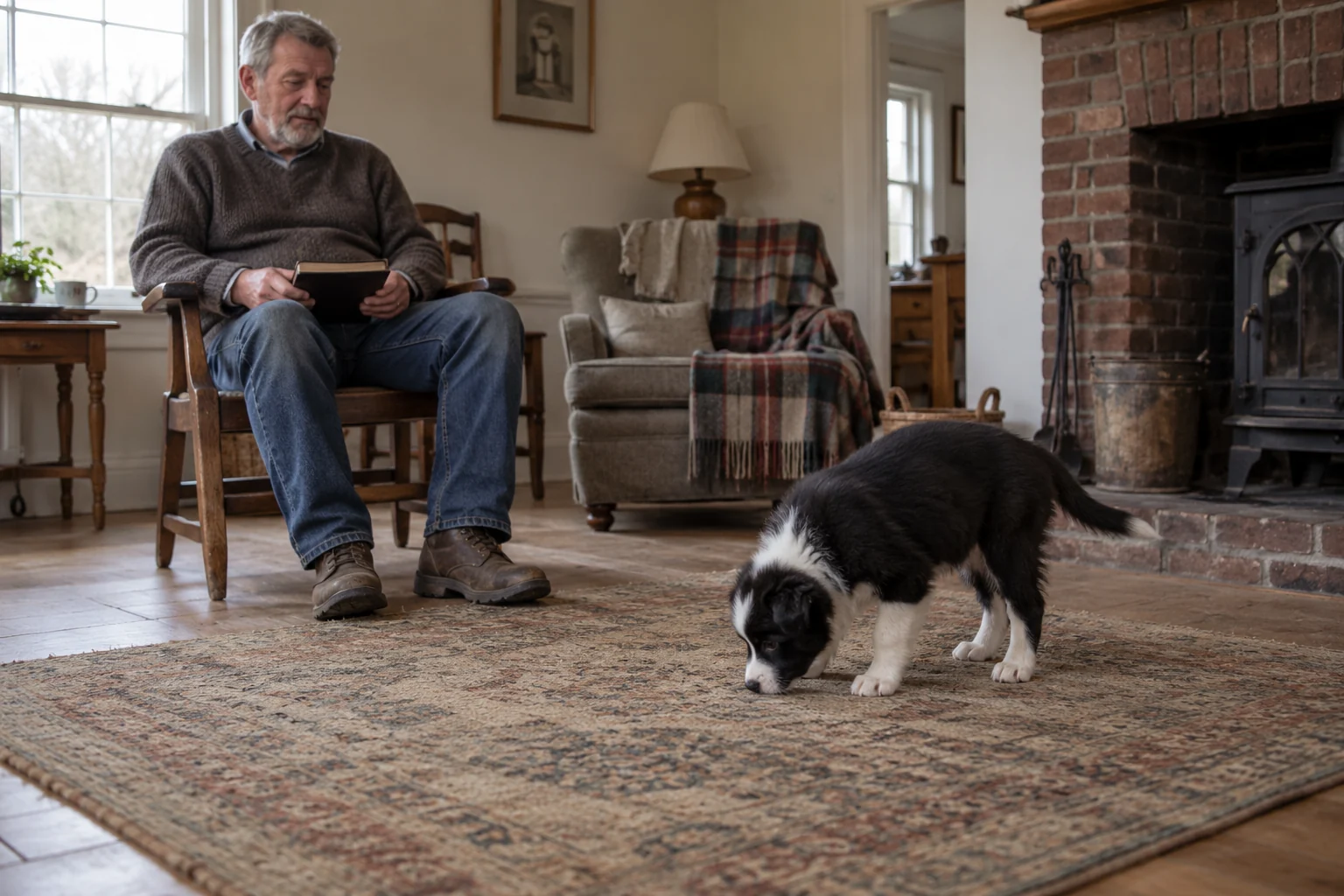
Begin with the question
Before discussing a puppy’s score, ask what happened during the assessment. Who was present? What did the puppy encounter? How was the response recorded? A label such as “confidence” can hide quite different activities and judgments.
A one-day assessment may add a structured description to what caretakers already know. The harder question is whether that result predicts the behavior you care about later. A useful description today and a reliable prediction of adult life require different evidence.
A 2024 scoping review examined 392 behavior-testing articles and found substantial differences in methods and terminology. Only a minority reported measures of validity. The review covers many kinds of dogs and tests; it does not assign an accuracy rating to every puppy assessment. Moser et al. ↗
How stable is behavior?
Fratkin and colleagues combined 31 studies of behavior measured at different times. Their overall correlation was 0.43. Ages, measures and populations varied; the review’s “puppy” category included dogs under 12 months. It is broader than a test of seven-week-old puppies. Fratkin et al. ↗
A published estimate, with its uncertainty
Fratkin et al. (2013) · 31 studies · dogs of varied ages and roles

| Statistic | Value |
|---|---|
| Correlation | 0.43 |
| 95% confidence interval | 0.35–0.50 |
| Studies | 31 |
The interval describes uncertainty in the pooled estimate, not the range of possible outcomes for an individual puppy.
Download the extracted estimate (CSV)Translate the number
Correlation describes how measurements vary together. A positive value means higher values at one time tend to accompany higher values later. It does not tell you how many puppies a breeder placed successfully, or whether a particular dog will enjoy a particular household.
To answer a placement question, you would need evidence about that decision: the assessment, the dogs, the homes, the later outcome and how success was defined. A familiar-looking test is not enough to bridge those differences.

A more specific study
Riemer and colleagues studied Border collies at several ages. Their early assessments showed little correspondence with the later tests; exploratory activity was the only behavior significantly related between the puppy and adult assessments. One breed and incomplete adult follow-up limit how broadly the finding applies. Riemer et al. ↗
Why the results differ
The meta-analysis asks about consistency across a broad research literature. The Border collie study asks what very early assessments reveal about later pet-dog behavior. Their different scopes help explain why one finding cannot stand in for the other.
Neither paper validates every branded test or supplies a formula for selecting a family. Keep the claim attached to the actual evidence.

Keep the description useful
Talk about concrete behavior in context. What did the puppy do during the assessment? Is that similar to what caretakers have noticed on other occasions? Are the descriptions consistent, or do they leave questions worth discussing?
Repeated notes add context; they are not automatically a validated prediction tool. Avoid converting an impression into a certainty simply because several people agree with it. Equally, a test result does not erase an important concern observed outside the test.
Families can use an honest account of present behavior, care needs and uncertainty. A claim that a puppy has been certified as a particular lifelong “type” asks more of the evidence than these studies provide.
Before relying on the score
Use the sheet to organize a discussion with the assessor. Ask what the test was designed for and what happened when researchers checked the intended outcome later.
Keep unanswered questions visible. They are part of understanding a result, not an inconvenience to remove from the story.
Blank working sheet
A discussion aid, not a placement score or a validated assessment.
Download an editable text copyFollow the evidence
PLOS ONE 8:e54907 (2013). Methods and Overall Consistency results; 31 studies. Original figure uses the published random-effects estimate and confidence interval. CC BY.
PLOS ONE 9:e101237 (2014). Abstract, Subjects and Tables 7–10. Border collies followed from early tests to adulthood. CC BY.
Frontiers in Veterinary Science 11:1455574 (2024). Scoping review of 392 articles; Methods, Results 3.1.4 and Discussion. Broad testing literature, not a puppy-test accuracy study.
Sources checked October 10, 2026.
Finished reading?
Keep track of the guides you’ve explored.